How Accurate Is Oppenheimer? Separating Fact From Fiction
Early in Oppenheimer, a young J. Robert Oppenheimer injects an apple with poison and leaves it on his professor's desk. It's such a strange moment that it's easy to assume Christopher Nolan made it up.
He didn't. The apple really happened. And that's a good summary of the whole movie: Oppenheimer gets the big moments of the true story right, then speeds up the timeline and adds a little drama around the edges.
Directed by Christopher Nolan, the 2023 movie stars Cillian Murphy as the theoretical physicist who led the lab at Los Alamos that built the first atomic bomb. It follows him from his student days to the Trinity Test in July 1945, and then to the 1954 hearing that stripped away his security clearance. Here's how it compares with history.
The poisoned apple was real, but the rescue wasn't
In the movie, Oppenheimer is studying under Patrick Blackett (James D'Arcy) at Cambridge. He injects Blackett's apple with potassium cyanide, then changes his mind and rushes back to knock it away before anyone takes a bite.
Oppenheimer really did study at Cambridge's Cavendish Laboratory, from 1925 to 1926, after graduating from Harvard summa cum laude in just three years. He was clumsy in the lab, Blackett was a demanding teacher, and by the fall of 1925 the then-22-year-old Oppenheimer was struggling badly.
So he used chemicals from the lab to poison an apple on Blackett's desk. There's some debate about exactly what he used and how much. This isn't the kind of thing that gets written down at the time. We know it happened because Oppenheimer confessed it to a friend. It was most likely cyanide, and probably not enough to kill.
The dramatic rescue is where the movie takes some license. The sources I found only say that Blackett threw the apple away without ever knowing it had been poisoned. There's nothing I could find suggesting Oppenheimer had a change of heart, or that he was even there when it was tossed.
Niels Bohr didn't send him to Germany
During the apple scene, the movie has Niels Bohr suggest that Oppenheimer leave the lab behind and study theoretical physics in Germany under Max Born.
Oppenheimer did meet Bohr at Cambridge, and it must have been a thrill. Bohr had won the Nobel Prize in Physics in 1922. But it wasn't Bohr who pointed him toward Born. In the true story, Oppenheimer met both men while he was at Cambridge, not necessarily at the same time, and decided on his own to move to the University of Göttingen. The movie simply folds two meetings into one conversation.
Theory suited him much better than lab work. He finished his PhD at Göttingen in March 1927 and co-authored the Born-Oppenheimer approximation with Max Born.
The movie skips back and forth in time, a lot
Early on, Robert Downey Jr.'s Lewis Strauss offers Oppenheimer the job of director at "the Institute." Because it's woven through Oppenheimer's early career, it's easy to assume it happened around then.
It didn't. Oppenheimer became director of the Institute for Advanced Study in 1947, after the war. Here's the real order of events:
- 1929: returned to the U.S. as an associate professor at UC Berkeley
- 1930 to 1942: taught at both UC Berkeley and Caltech, building Berkeley's theoretical physics program into something well known
- 1942: given leave to work on the Manhattan Project
- 1947: left both universities to lead the Institute for Advanced Study
The movie's take on Einstein fits, too. After visiting Princeton in 1935, Oppenheimer wrote to his brother that "Einstein is completely cuckoo." The two men disagreed about quantum theory but stayed cordial, and when Einstein died in 1955, Oppenheimer wrote that physicists had lost their greatest colleague.
Jean and Kitty: right story, compressed timeline
The movie shows Oppenheimer dating Jean Tatlock (Florence Pugh), getting Kitty Harrison (Emily Blunt) pregnant while she's married to someone else, breaking up with Jean, marrying Kitty, and later having an affair with Jean again. That's essentially what happened, just spread over several years instead of a few scenes.
Oppenheimer met Jean in the spring of 1936, when she was a student at Berkeley. She shaped a lot of his left-leaning politics. He proposed twice. She said no both times, and she ended the relationship in the spring of 1939.
A few months later, in August 1939, he met Kitty at a party. She was on her third marriage at the time, to Richard Harrison, and the affair that followed wasn't much of a secret. Kitty divorced Harrison on November 1, 1940, already pregnant with their first child, Peter, and she married Oppenheimer the very next day.
Within a couple of months, Jean was back in his life. He spent his first New Year's as a married man with her, and they stayed in contact a few times a year after that. Kitty knew about it by 1943 at the latest, because the FBI's wiretaps caught Oppenheimer saying he'd told her.
Jean Tatlock died in January 1944. Her death was ruled a suicide, though some details around it have fueled questions ever since. Oppenheimer himself believed it was suicide.
The FBI really was listening
That wiretap is worth pausing on, because it's one of the things the movie gets right. The FBI began monitoring Oppenheimer in March 1941 over his Communist associations. That was before he was ever recruited for the Manhattan Project, and the surveillance didn't stop once he was running its most secret lab.
Groves didn't find him out of nowhere
In the movie, Matt Damon's General Leslie Groves suggests Oppenheimer's name didn't even come up in the search for a director. The impression is that Groves plucked him from obscurity.
In the true story, Oppenheimer was already deep in the work. After the U.S. entered the war, Nobel laureate Ernest Lawrence brought him in to work on fission at Berkeley. From July to September 1942, Oppenheimer led a group of theoretical physicists working out the principles of a bomb design. That's why Groves recruited him on October 15, 1942 to lead what was called Project Y, at Los Alamos.
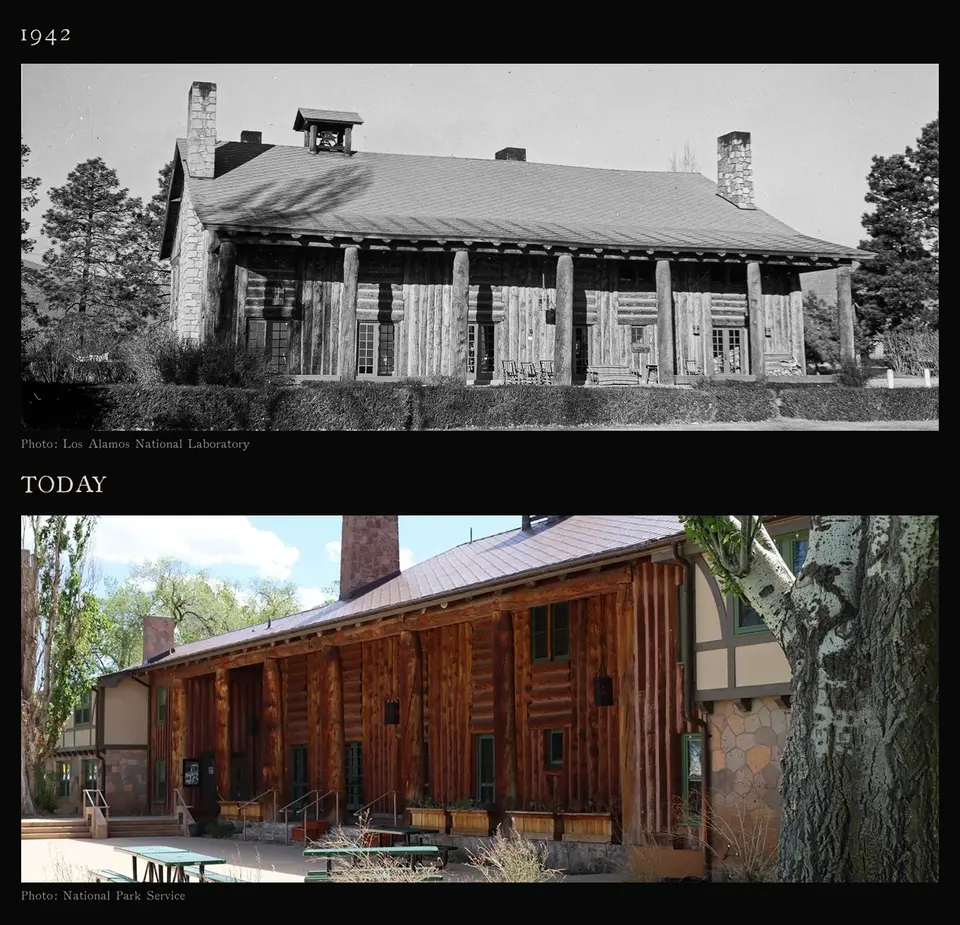
Fuller Lodge in 1942 and today. The old Ranch School dining hall became a community center for Manhattan Project workers at Los Alamos.
The movie also can't show the true scale of the project, and it doesn't try. It's called Oppenheimer, after all. Los Alamos had roughly 6,000 workers. The sites producing the materials were far bigger: about 50,000 people at Hanford, Washington, making plutonium, and another 75,000 at Oak Ridge, Tennessee, enriching uranium.
Yes, they worried about igniting the atmosphere
One of the movie's tensest ideas is that the first bomb might set off a chain reaction that burns up the atmosphere. That fear was real. Physicist Edward Teller raised it as early as 1942.
So they did the math. The risk was described as "nonzero," meaning tiny but not technically impossible. Hans Bethe and Emil Konopinski showed that the reaction couldn't keep going, because the air gets too thin and cool for it. Their formal paper wasn't published until 1946, but the calculations were done before the test.
Trinity is one of the movie's most accurate scenes
The Trinity Test on July 16, 1945 is staged about as faithfully as anything in the film. About 425 people were there, and Oppenheimer and Groves watched from the S-10,000 bunker, about 5.7 miles from ground zero. The dark goggles were real. (Richard Feynman famously skipped them and watched through a truck windshield.) The bomb went off at 5:29 a.m.
Two details are worth knowing. The name "Trinity" comes from John Donne's poem Holy Sonnet XIV, which is the line Oppenheimer quotes in the movie. And "Now I am become Death, the destroyer of worlds" was never said out loud at the test. Oppenheimer said in a 1965 NBC documentary that the verse from the Bhagavad Gita came to mind as he watched.
The movie's list of target cities is simplified. The Target Committee, which Oppenheimer chaired, started with about 16 Japanese cities and narrowed them to five by the spring of 1945.
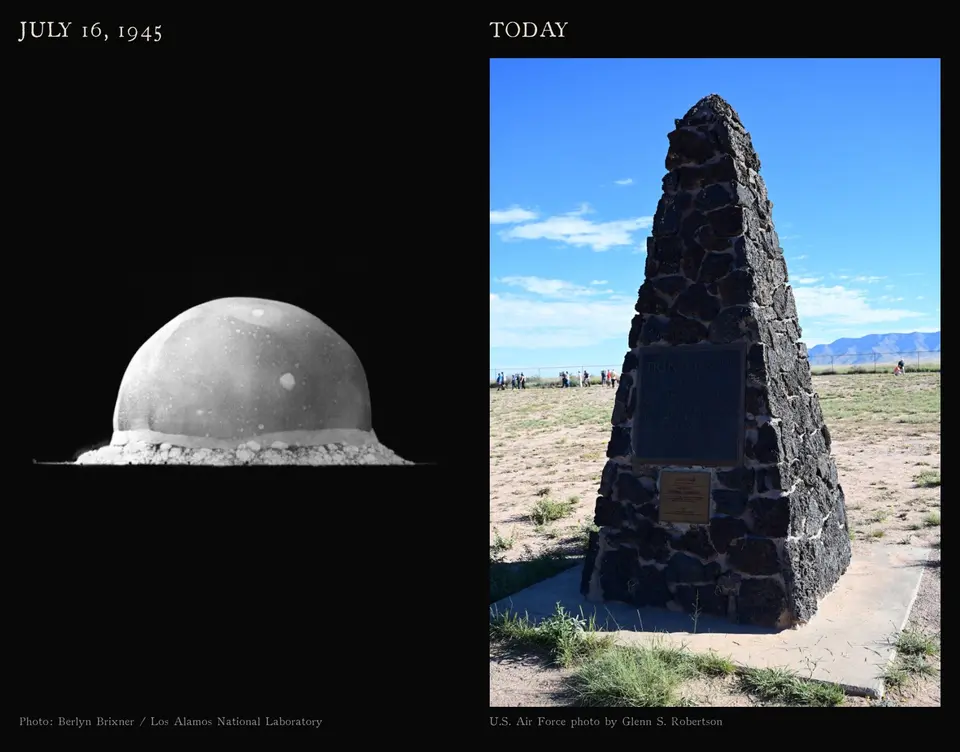
Ground zero on July 16, 1945, and the black lava-rock obelisk that marks the spot today.
Truman's "crybaby" line didn't happen in front of him
The October 25, 1945 meeting with President Truman was real, and Oppenheimer really did say he felt he had blood on his hands. In the movie, Truman calls him a "crybaby" loudly enough for Oppenheimer to hear on his way out.
In the true story, Truman's harshest comments came after Oppenheimer had already left, and some accounts suggest the "crybaby" line came later, in a letter. Either way, Truman was no fan.
Strauss really did hold a grudge
The movie's version of Lewis Strauss turning on Oppenheimer is dramatized, but the core is accurate. The turning point was a 1949 congressional hearing where Oppenheimer publicly mocked Strauss's views on exporting radioactive isotopes, saying they were less important than electronic devices but more important than vitamins. The National Park Service and Los Alamos National Laboratory both describe Strauss's look of hatred in that moment.
In 1953, Strauss asked the FBI to track Oppenheimer and sent its report straight to President Eisenhower, who decided to revoke Oppenheimer's clearance. Oppenheimer appealed, and a three-man panel voted two to one against him, as the Hoover Presidential Library explains. His government career was over.
The verdict
Oppenheimer is more accurate than most biopics. The strangest parts, like the poisoned apple, the wiretaps and the fear of igniting the sky, are the parts that really happened. Most of what it changes is timing, rearranged so the story moves.
The one place history kept going after the movie's story ends is the hearing. In 2022, the U.S. Department of Energy vacated the 1954 decision, calling it a flawed process that broke the Atomic Energy Commission's own rules. It took 68 years, but the record finally caught up with the man.
[DAN: optional one-line personal note, e.g. why Oppenheimer was the movie that brought solo episodes back]
I dug into much more of this, including the Truman meeting and the controversy around Jean Tatlock's death, on Based on a True Story. Listen to the full Oppenheimer episode here.
Sources
The full source list from the episode is at basedonatruestorypodcast.com/382. Sources linked in this article: