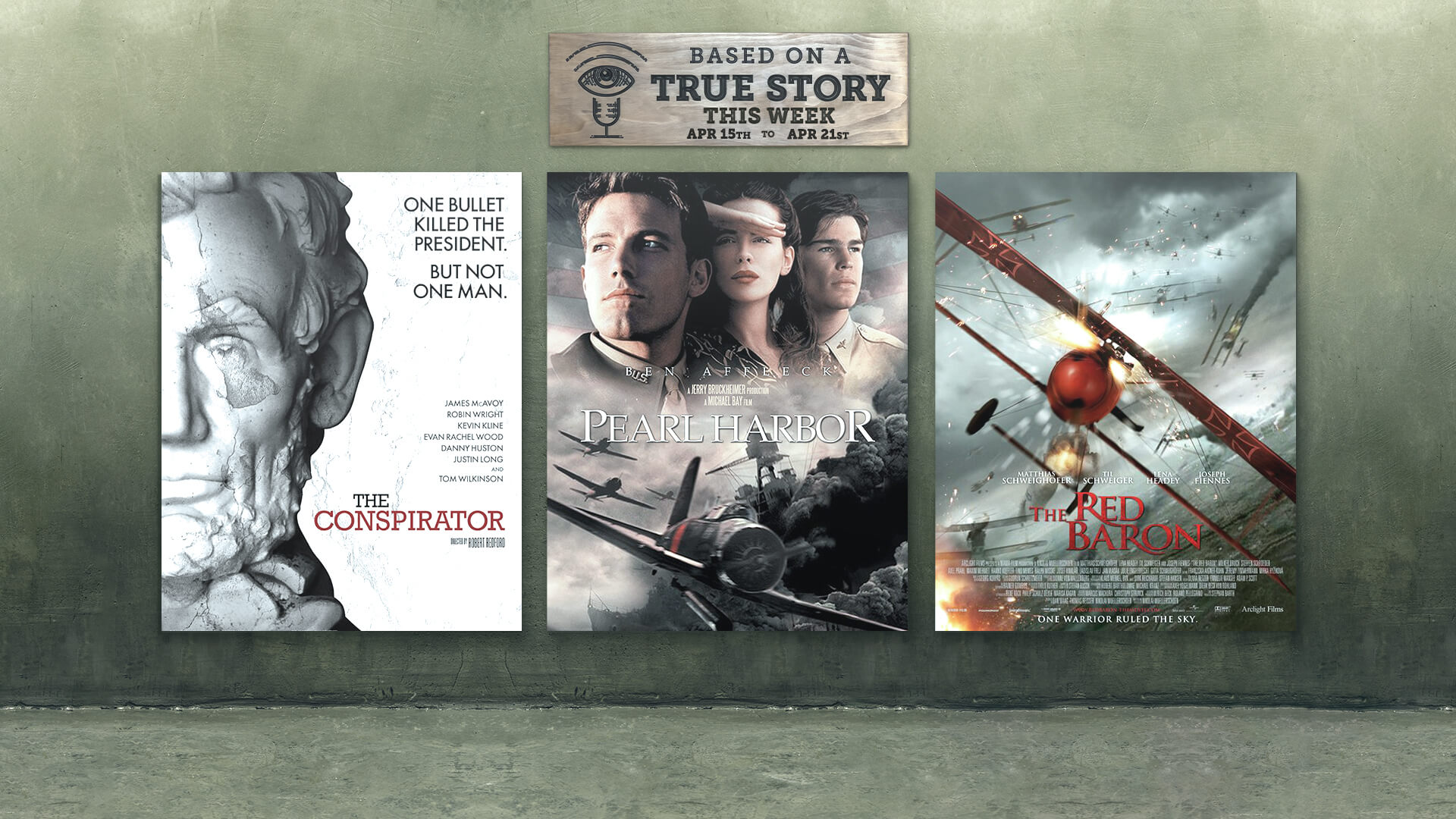
BASED ON A TRUE STORY (BOATS EP. 379) — Most movies focus on the surprise attack at Pearl Harbor, but the true story of December 7th, 1941, involves a coordinated global offensive across the Pacific. In this episode, history professor Joshua Donohue returns to explore what the movies miss—including attacks on Wake Island, the Philippines, and military installations across Oahu that extended far beyond the harbor itself. From civilian casualties to pilot heroics to the international scope of Japan’s ambitious assault, we separate fact from fiction across multiple Pearl Harbor films.
Read Josh's Latest Work
Disclaimer: Dan LeFebvre and/or Based on a True Story may earn commissions from qualifying purchases through our links on this page.
Listen to the audio version
Did you enjoy this episode? Help support the next one!

Transcript
Note: This transcript is automatically generated. There will be mistakes, so please don’t use them for quotes. It is provided for reference use to find things better in the audio.
00:00:02:01 – 00:00:30:17
Dan LeFebvre
Hello and welcome to Based on a True Story, the podcast that compares your favorite Hollywood movies with history. Today is December 7th, which means exactly 84 years ago is when the United States was violently rushed into World War Two with a surprise attack at Pearl Harbor. Now, if you’re a long time fan of the show, you’ll know that we’ve covered numerous movies depicting this event over the years, from 1970s toward toward Tora, and 2001 Pearl Harbor to 2000 and nineteenths midway.
00:00:30:19 – 00:00:53:03
Dan LeFebvre
Today, we’re going beyond what the movies show us, because most movies talk about the surprise attack at the harbor itself. But in the true story, that was just one part of the Japanese offensive on December 7th. And to do that, we’ll be looking at a range of different movies to get a sense of when and where the numerous attacks took place on that day, not just in Hawaii, but around the world.
00:00:53:05 – 00:01:15:11
Dan LeFebvre
Returning to based on a true story to help us unravel the true story beyond Pearl Harbor in the movies is Joshua Donahue, the adjunct professor of history at two different colleges, Suffolk County Community College and Farmingdale State College. Before we get started, though, let’s set up our game for today’s episode. Now, if you’re new to the show since based on a true story, it’s all about separate fact from fiction in the movies.
00:01:15:13 – 00:01:34:11
Dan LeFebvre
You’ll get to practice your skills at separating fact from fiction in this podcast episode with a game of two truths and a lie. So I’m about to give you three things that we’ll talk about in this episode. Two of those are true, and one of them is just an all out lie. Are you ready? Okay, here they are.
00:01:34:14 – 00:02:04:29
Dan LeFebvre
Number one, Wake Island was attack just a few hours after receiving word of the attack on Pearl Harbor. Number two, Phil Rasmussen went up in his P30 six wearing pajamas and landed with about 500 bullet holes in his plane. Number three in addition to military targets, the Japanese attacked numerous civilian targets around Pearl Harbor. Got him. Okay, now, as you’re listening to our story today, see if you can figure out which one of those is the lie.
00:02:05:02 – 00:02:28:09
Dan LeFebvre
And if you’re watching the video version of this, you’ll see I’m holding up this envelope. This has the answer inside, and we’ll open it up at the end of the episode to see if you got it right. Okay. Now it’s time to connect with Joshua Donahue to go beyond Pearl Harbor in the movies.
00:02:28:11 – 00:02:51:11
Dan LeFebvre
Today’s episode is a little different than the typical episode of based on a true story, because we’re not talking about just one movie’s timeline. Instead, we’re flipping it around to focus on the timeline of events before, during, and after the attack at Pearl Harbor and then pulling from an array of movies about Pearl Harbor to get a deeper understanding of history beyond what we see in the movies.
00:02:51:13 – 00:03:16:03
Dan LeFebvre
So let’s start today with a classic film from the year 1953 starring Burt Lancaster, Deborah Kerr and Frank Sinatra called From Here to Eternity. Most of this movie depicts life before the surprise attack at Pearl and it shows what life was like for the US military in 1941. And if we’re to believe the movie’s version of events, things in Hawaii before the attack were calm.
00:03:16:06 – 00:03:41:28
Dan LeFebvre
The movie throws in some internal drama among the men stationed there, but it’s soldiers chasing promotions and women. There’s no mention of the conflicts going on around the world, so after watching that movie, I was left with the impression that basically the average person on Pearl before the attack lived in their own little bubble. Is that a fair assessment of what it was like for the military before the attack at Pearl?
00:03:42:00 – 00:04:11:08
Joshua Donohue
Yes, it absolutely was. And you just mentioned the movie really kind of focuses more so on the, the love story. And as it really it compares in a lot of ways to, the 2001, Michael Bay film, of course, starring, Ben Affleck, Josh Hartnett, Kate Beckinsale. So, going into the film here, eternity, it’s a I really enjoy this movie and it has plenty of drama to it.
00:04:11:15 – 00:04:31:29
Joshua Donohue
And really with the backdrop and the climactic event, you know, I was thinking, you know, it’s the Pearl Harbor films are almost like in a lot of ways, it’s like the Titanic. All right. You know, you know what’s coming. But there’s all this buildup and all this drama that happens before it so gets to sort of, you know, pander to different audience, cater to different audiences, I should say.
00:04:32:04 – 00:04:54:18
Joshua Donohue
But from what I read, the novel is between 80 to 90% accurate. And it would take private James Jones’s. And it’s based on his memoirs, A Full Decade from the writing in the publication, from his first novel, From Here to Eternity, in the autumn of 1951. So the central narrative of the book draws upon Jones’s two years at Schofield Barracks.
00:04:54:25 – 00:05:23:15
Joshua Donohue
And this would, of course, culminate with the attack on Pearl Harbor. So he was a boxer or a bugler. Those things are touched upon in the film. And Ken played by his character, Robert Lee Prewitt. So there is definitely an air of confidence where I would say overconfidence that existed on Oahu. And what you notice in From Here to Eternity that you usually don’t see much in regard any way of concern, for a potential Japanese attack to occur.
00:05:23:18 – 00:06:00:18
Joshua Donohue
While the film largely centers on the two really separate romantic, themes between, Sergeant Milton Warren, played by Burt Lancaster, and Karen Holmes, played by actress Deborah Kerr, the other between Montgomery Clift character Robert E Lee Prewitt and the actress, binary, who plays Alma Lorene Burke. So what I did like about the film itself is this authenticity of especially the scenes that Schofield you see the military, mustering in the training and again, the marching that you see in the film, again, taking place on the parade ground and Schofield Barracks.
00:06:00:20 – 00:06:22:27
Joshua Donohue
So since the film was released in 1953, barely ten years after the actual attack, it really does. Well, as far as its authenticity of military light both on and off the off the base. So the men have the proper period gear. You see the World War One era, the Brody helmet, the 1903 Springfield rifle. That was period correct.
00:06:23:00 – 00:06:48:29
Joshua Donohue
The uniforms, the gear, etc.. Any sort of, you know, history nerd like myself is really going to appreciate those little details. And films. So Army life at Schofield was very regimented, as you see in the film. Revelry at 6 a.m.. Roll call at 630. Breakfast barracks detail, uniform inspection, calisthenics, Infantry drill, mail call, noontime lunch after work duties and 5 p.m. retreat.
00:06:49:06 – 00:07:11:06
Joshua Donohue
And then, the ceremonial lowering of the flag. Evenings were free, so Jones and his comrades would hang around the base or went into the neighboring village, of Louis. Wally, I should say, to drink and sort of view, you know, carouse and everything that they were doing in the film. So the, the men really made few trips to Honolulu since the bars.
00:07:11:06 – 00:07:38:26
Joshua Donohue
They’re really too expensive for the humble enlisted men. You know, maybe the officers went into town there. Schofield life there really emphasize also intramural sport, which is also a theme with each company fielding football, baseball, basketball, track, boxing, boxing. You see, as a theme as well. You can also reference that to the Pearl Harbor film of 2001, Doris Miller, the character played by Cuba Gooding Jr.
00:07:39:03 – 00:08:04:12
Joshua Donohue
And and all the heroics that, again, is also portrayed in Tora Bora. Tora miller was the, boxing champion heavyweight champion on this ship, the USS West Virginia, which was sunk, at Pearl Harbor. So during Jones’s time at Schofield Barracks, his company won three regimental championships, athletic mediocrity. You know, notwithstanding, they took part in boxing.
00:08:04:12 – 00:08:27:06
Joshua Donohue
Football. He would hurt his ankle in the latter. And this injury would continue to bother him for several months. So it also captures the typical nightlife in Oahu, in Honolulu with Oahu, the bars there, the, the brothels, etc.. Hawaii was far from home for the servicemen who were stationed there. So they wanted to make most of their time.
00:08:27:13 – 00:08:46:12
Joshua Donohue
It was a great obviously post during the there were a tropical, place. So the scene where the men were eating breakfast at the mess hall at Schofield Barracks, which was two miles, from Wheeler Army Airfield, which was again based on the accounts, Private James Jones, you see the great scene there where they’re having breakfast on the Sunday morning.
00:08:46:12 – 00:09:14:08
Joshua Donohue
They’re at Schofield, barracks, mess hall. And all of a sudden, you hear, the explosions, taking place, outside. And what I also really enjoyed about the film is that you see actual footage of the attack happening. Oh, the the Arizona exploding, which is obviously the most famous image, captured of the attack. So it’s, I think the the film does a good job really capturing what it was like.
00:09:14:08 – 00:09:22:07
Joshua Donohue
It really was not a whole lot of, you know, fear. And as it was after the attack, it was completely different climate altogether.
00:09:22:09 – 00:09:40:17
Dan LeFebvre
It puts a whole new spin on it. And we all know it as, you know, a surprise attack. But just the, the, the contrast of what we see in, you know, from here to eternity. And, and it’s like you’re saying a post to a tropical location. It’s, it almost seems like they’re on vacation and, you know, there’s really nothing to worry about.
00:09:40:17 – 00:09:45:11
Dan LeFebvre
And then all of a sudden they’ve got stuff to worry about. You know, a.
00:09:45:13 – 00:10:13:18
Joshua Donohue
Whole new ballgame. It’s it’s no longer a tropical, you know, I’ll get into a little bit later. But yeah, after the attack, the entire life on Oahu changes 180 degrees. And it goes from this, you know, great nightlife and great post and, and kind of getting into trouble and drinking women, all these sorts of things to blackouts, to drills to, you know, a martial law which will be declared, following the attack.
00:10:13:20 – 00:10:32:23
Dan LeFebvre
Well, you mentioned Tora, Tora tours. So let’s move on to that one. It’s a 1970 film, just probably one of the most common movies depicting the attack on Pearl Harbor. The first half of that movie is all about the events leading up to the attack, and we find the U.S. military trying to figure out where the Japanese are going to attack.
00:10:33:00 – 00:10:57:08
Dan LeFebvre
They think it might be the Philippines, or maybe Thailand or maybe Borneo. They don’t seem to think the attack will be at Pearl Harbor, which of course we know from history factored into why it was such a surprise attack like we were talking about, because the movie then focuses mostly on the surprise attack at Pearl. It seems to imply that perhaps those other locations that just mentioned weren’t targets.
00:10:57:09 – 00:11:09:20
Dan LeFebvre
Now, correct me if I’m wrong, but didn’t the Japanese also launch attacks in other locations? Other than Hawaii, such as Wake Island? Can you give some more context around the scale of the Japanese offensive in December 1941?
00:11:09:22 – 00:11:42:11
Joshua Donohue
Yeah, that’s absolutely correct. And it at that point in time, the Japanese military between the ground, sea and air operations were seemingly everywhere in the Pacific, especially following the attack on Pearl Harbor. Keep in mind the midway, another film that depicts the attack, obviously, you know, fast forwarding into June of 1942, while that climactic battle will take place, actually, midway is struck also, during that that time period as well, that morning, by a pair of Japanese destroyers, you know, nominal damage.
00:11:42:11 – 00:12:09:03
Joshua Donohue
But again, it’s it’s again a multi-pronged attack. Wake Island, as you mentioned, located about 2000 miles, to the west of the Hawaiian Islands, was struck about four hours after receiving word by radio from Pearl Harbor that it was under attack. So all of these locations, really from, wake on over the Philippines, Hong Kong, obviously. Or it’s December 8th, 1941, since it’s lying on the other side of the International Date Line.
00:12:09:06 – 00:12:40:07
Joshua Donohue
So the story of wake itself is often forgotten amidst the attack on Pearl Harbor and bases on Oahu. The 1942 film starring Brian Dunne, Levy, Robert Preston and McDonnell Carey was the first time that Americans really had a visual sense of of somewhat what happened there. Although it was not accurate in many ways, especially the ending part, where the Japanese who says basically come and take, you know, come and get us and, you know, the island falls and the Americans fight to the last man.
00:12:40:09 – 00:13:13:06
Joshua Donohue
That’s obviously not what happened. Most of the wake veterans who later saw the film, after they returned home from Japanese P.O.W. camps, didn’t really think too much of it just due to the just the overload of inaccuracies in it. And, of course, wake would fall to the Japanese on the 23rd of December, 1941, after a fierce 16 day battle work in the American garrison, there was about 450 Marines, about 1200 civilians who are in charge of, you know, building, the government contract with the base facilities, road networks, these types of things.
00:13:13:06 – 00:13:42:26
Joshua Donohue
So, the island falls and the Japanese will capture and will be held, all the way through until the end of the war. So the, the Japanese forces also began landing, in the Philippines. And on December 8th, 1941, they would seize most of the island of Luzon by December, December 24th and more than 120,000 Japanese troops were committed during, the battle and against a force of about 150,000 American and Filipino defenders.
00:13:42:28 – 00:14:09:07
Joshua Donohue
So amphibious landings were there, were supported by air attacks, fighters and bombers, coming in from the island of Formosa, which is modern day Taiwan. So these air attacks devastated the Far East air Force, much of which was destroyed on the ground, as we see happened to Pearl Harbor. All of those aircraft just parked out in the open wingtip to wingtip, for fear, obviously, that was going on with Jack with, you know, fear of Japanese sabotage.
00:14:09:12 – 00:14:37:18
Joshua Donohue
So Japanese, you know, aviators were just looking at these targets out in the open. All they had to do is simply just press the trigger. So the invasion force that was sent to the Philippines consisted of, the Japanese 14th Army under the command of general Masaharu Homma. And at about 3:40 a.m. on December 8th, 1941, The Fallen Ring, Lieutenant General Douglas MacArthur’s lavish apartment atop the Manila Hotel.
00:14:37:21 – 00:14:57:15
Joshua Donohue
It was MacArthur’s chief of staff telling him about the news about Pearl Harbor and that MacArthur, again as the commander of American forces in the Philippines, he had sort of wrestled what what to do next? Should he attack Formosa? Should he not? And there was bad weather in the area which actually prevented the Japanese from attacking.
00:14:57:20 – 00:15:23:24
Joshua Donohue
So MacArthur doesn’t really seize the initiative here before he authorizes the strike. It’s it’s far too late. So, the Japanese, you know, would again eventually take the Philippines and again, you would have the fall of Corregidor, soon after the fall of Bataan. They had again occupied Korea, Southeast Asia, Malaysia, Formosa, and large portions of the Chinese mainland.
00:15:23:24 – 00:16:08:14
Joshua Donohue
And they would also occupy, the Solomons, the Gilberts, the Marianas, the Carolinas, the Marshall Islands. So there were literally, no bases between Hawaii and Japan. And the first Japanese landings also would take place in December 8th in northern Malaya, in southern Thailand. So, General Yamashita, on the 10th of December, had penetrated the Malayan frontier all the way, to the city of kata and eventually sinking the Japanese, to the two British battleships, I should say the HMS Prince of Wales and the HMS repulse, which enabled the Japanese now to continue landing their troops, establishing bases in Malaya with really without any limit, really limited Allied interference.
00:16:08:21 – 00:16:46:01
Joshua Donohue
So they, had again advanced all over Southeast Asia and in places all around, they continued. Then by February the 15th, the defenders had driven back to the suburbs of Singapore. And again, food and water supplies were low and that evening, British general Arthur Percival would surrender to the Japanese. So again on 8:00 on this eighth, December 1941, eight hours after the Pearl Harbor attack, again, it had been a disaster, and it would continue to be one bad piece of news after another.
00:16:46:04 – 00:17:07:10
Joshua Donohue
Guam would also be attacked and it would fall. Hong Kong, it would also form what would be termed, Black Christmas. When Hong Kong was surrendered to the Japanese on December 25th, 1941. So pretty much from, you know, the beginning of December, right from the Pearl Harbor attack on the Japanese were were everywhere. And really, we were really, really on the ropes.
00:17:07:13 – 00:17:30:27
Dan LeFebvre
And it sounds like, from everything happening on December or December 8th across the International date line, like with Wake Island and the Philippines, one unique thing about Pearl Harbor, other than being, you know, part of the United States instead of, you know, a territory, is they didn’t have boots on the ground like they did in some of these other places.
00:17:30:27 – 00:17:49:15
Dan LeFebvre
And so it seems like almost I mean, I don’t want to make it seem like Pearl Harbor wasn’t a devastating attack, but, you know, they didn’t land boots on the ground and and actually capture it and take it over, like they did in Wake Island. So, I mean, just the logistics of that of of all of that at once.
00:17:49:15 – 00:17:56:12
Dan LeFebvre
I mean, the logistics of the attack at Pearl Harbor alone. But the logistics of, of all of that just had to be massive.
00:17:56:14 – 00:18:28:04
Joshua Donohue
Yeah. And that’s that’s really where America found itself when Pearl Harbor was attacked. And again, things could have been much worse. A lot of people don’t really think about it as much of a disaster as the attack really seemed. And again, there was you didn’t have the real time information that we have nowadays, and news sort of still traveled really slowly back and, you know, 1941, but once the smoke starts to clear, the, you know, the Japanese didn’t sick of the aircraft carriers.
00:18:28:04 – 00:18:50:24
Joshua Donohue
Luckily that day there were, you know, the USS Lexington was, bringing fighters to midway at the time, and the USS enterprise was coming back from Wake Island. It had delivered the, forward echelon of VMF to 11, under, a major Paul Putnam. Those 12 fighters were b the only Air force that Wake Island would have throughout the the entire siege.
00:18:50:26 – 00:19:10:03
Joshua Donohue
Seven of them were completely destroyed on the ground when the Japanese hit. They really only had four aircraft. Really that the most at a time. And little by little, those numbers were kind of whittled down as the attack went on. They were literally scavenge scavenged, salvaged parts from, you know, derelict planes to put them on usable ones and fly them.
00:19:10:03 – 00:19:31:10
Joshua Donohue
And just the, the engineering and the ingenuity, on the ground there at wake in the stories I’ve read about the accounts there, it’s just it’s almost like a heavyweight fight and just two boxers just going at it, you know, the Marines being, you know, the the unmanned underdog. But they just kept fighting and fighting and fighting until the Japanese, you know, just, you know, brought everything to bear.
00:19:31:11 – 00:19:52:28
Joshua Donohue
They actually thwarted an amphibious invasion three days after that, sunk a, a destroyer. Henry Elrod sunk another following, few hours later with small bombs from little Wildcat fighters. And that’s how the that how much the fighting spirit you would get the, you would receive the Medal of Honor for that. He would not actually survive the battle.
00:19:53:01 – 00:20:03:28
Joshua Donohue
He was killed on the very last day in the morning, and from Japanese fire. So in the wake story, you know, it’s it’s tied to Pearl Harbor in many ways. And, it’s it’s pretty remarkable.
00:20:04:05 – 00:20:24:10
Dan LeFebvre
If we go back to Hawaii and back to to water to the first wave of Japanese planes that we see there, in the movie take off from their carriers as the sun is rising on December 7th, 1941. And we see them flying across Oahu’s farmland and right to Pearl Harbor, where they ultimately commence the first wave of attacks at Pearl.
00:20:24:12 – 00:20:43:00
Dan LeFebvre
And while the movie does show a few other things like USS firing on a Japanese sub just outside Pearl and the B-17s, it got mixed up in the raid on Pearl. Those are all tied to the attack at the base at Pearl Harbor. So I can see how someone watching that movie might think that Pearl Harbor was the only place surprised by the attack.
00:20:43:03 – 00:20:49:04
Dan LeFebvre
Were there any other military installations in Hawaii that were surprised by a Japanese attack on December 7th?
00:20:49:06 – 00:21:16:06
Joshua Donohue
Yeah, and the Japanese first attack, wave, was assigned many fighters and bombers, specifically, purpose for the air base, suppression of all the fighter bases around Oahu. So the fighters set the planes afire with the machine gun and cannon fire. As I mentioned, they’re all parked out in the open. And all of the, you know, all the installations across, you know, every one Wheeler, every field, Kaneohe Bay, all out in the open again.
00:21:16:06 – 00:21:35:07
Joshua Donohue
There’s that fear of the Japanese sabotage. So they want to have visual, you know, a look at every single plane that’s out there. And it turns out to be an absolutely terrible decision. So literally all of the Japanese pilots have to do is just fly right in a straight line. And for the wing tanks and the planes are destroyed.
00:21:35:10 – 00:22:01:07
Joshua Donohue
The second attack wave also had airfield strikes among its tasks. So the subject of my latest article in World War two, history magazine, which is on newsstands now, I wrote about the attack on the Marine Corps Air Station at, Mooring Mast Field. It’s about seven miles to the west of Pearl Harbor, home to several squadrons of clothing, as I mentioned, a VMF 211, which was the, again, the same squadron sent to Wake Island.
00:22:01:07 – 00:22:20:29
Joshua Donohue
And lo, we fought the very last aircraft, after the initial seven were destroyed on the ground and the initial Japanese raid. So the base there was attacked that morning, a few minutes prior to the attack on Pearl Harbor, by the feared Mitsubishi A-6, m2 zero fighter, which at that time was the most dominant fighter in the skies.
00:22:20:29 – 00:22:51:11
Joshua Donohue
At that point, the Americans had no, real answer for it at the time. So any zero or, D3, a Val dive bomber, which and expended its ordnance at Pearl Harbor against the ships and the other the targets there would fly back and use whatever, ammunition or bombs that they had against every field ever field, unfortunately, had the luck, the bad luck of being located right near where the Japanese rendezvous point was when they were going to form up to fly back to the ship.
00:22:51:12 – 00:23:16:17
Joshua Donohue
So all of that activity flying out of Pearl Harbor, going in and coming out ever was really caught in the middle of that maelstrom. So you also had Wheeler Army Airfield in central Oahu, which was Hawaii’s main fighter base. It was also heavily attacked. Some 140 planes were on the ground there, merely P40 and P30 six pursuit planes, nearly two thirds were destroyed or put out of action.
00:23:16:19 – 00:23:41:18
Joshua Donohue
So a similar, proportion of B-17, B18 and A20 bombers at Hickam Army Airfield, which was located right next to, just looking to the east, or Pearl Harbor Navy in that Navy yard. It was also wrecked and damaged enough to keep all of them grounded. So many of the men, killed at Hickam when the Japanese bomber barracks, smaller Bellows Field was on eastern Oahu, was also hit.
00:23:41:24 – 00:24:22:23
Joshua Donohue
Just really mostly straight. I the a couple of Japanese, zeros. They destroyed a couple of P-40s trying to take off. Two pilots actually tried, into the teeth of that enemy onslaught. It was a, you know, again, an active it just, you know, courage and bravery. So the U.S. Navy and Marine Corps air stations on Pearl Harbor, Fort Island, at and ever and the West Pearl at Kaneohe, Bay near Bellows Field, again received all sorts of concentrated attention from the Raiders and was aircraft complement mainly carrier bombers and fighters, was reduced to nearly 50 operational planes to less than 20.
00:24:22:23 – 00:24:45:23
Joshua Donohue
So nearly every plane was either damaged or destroyed. So Fort Island in Kaneohe were also home to several squadrons of long range PBY patrol. Sea planes also attacked heavily, with Fought Island losing about half its planes in Kaneohe, all but a few. So the Naval Air Station, at Kaneohe Bay was bombed very, you know, particularly hard.
00:24:45:26 – 00:25:08:17
Joshua Donohue
It’s to the on the east coast of Oahu. It’s a major Navy ship, sea patrol plane base. And one of the main reasons why the Japanese would target these bases is because they didn’t want to have the risks run the risk of having any long range planes. Follow them all the way back out to find where the carriers were, and then you know exactly where they’re at, and they can send war attack planes to out against them.
00:25:08:24 – 00:25:31:06
Joshua Donohue
So it was imperative to the Japanese that they were attacking every single plane on the ground. And you also touched upon, the USS Woodward and the B-17s depicted, in Tora, Tora, Tora, these events truly what makes that film so true to life? Because there are really otherwise other really overlooked and other films about Pearl Harbor.
00:25:31:14 – 00:26:03:09
Joshua Donohue
They’re important because of the sinking of the Japanese mini sub, by the ward’s gunners. Again, it was contrary to popular belief, but it was was the Americans who actually fired the very first shot at Pearl Harbor. And again, the the tour. Tora, Tora! You know, with the P-40s, you know, we talk about them with the, both the George Welch and, Kenneth Taylor, as we see in the film itself and loosely portrayed in the 2001 film as well, we loosely, loosely portrayed.
00:26:03:09 – 00:26:28:23
Joshua Donohue
Yeah, for a variety of reasons. Yes. Yeah. Michael Bay gets a little carried away with those scenes. But the one, the one scene in Tora, Tortuga, which always blows me away, is the one seen at Wheeler Field, where you have the P-40 that’s hit and it crashes in to the flight line of other P-40s. You actually see it from different scenes, shot from different angles, but it’s the same scene.
00:26:29:00 – 00:26:45:27
Joshua Donohue
That was actually an accident, that that scene was not supposed to happen the way it did. And you see the way that you see those guys running for their lives, they’re really running for their lives in that scene. So look at that scene again. That was not some not meant to happen the way it was supposed to.
00:26:46:01 – 00:27:06:21
Joshua Donohue
Total. Luckily, no one was injured. But yeah, that was that was an interesting one. Also to note, and just in addition to those other bases, Kaneohe Bay, Hickam Field, Wheeler Bellows, Ford Island and ever you also have a lot of smaller coastal defense, forts that are in and around the Pearl Harbor area.
00:27:06:27 – 00:27:29:02
Joshua Donohue
You have Fort Armstrong, you have Fort Barrett. A soldier there was killed by a strafing Japanese plane. Fort de Russie, you have Fort Kamehameha. Seven men were killed or four wounded there. A soldier was also killed at nearby Fort Shafter, by an errant U.S. Navy shell, which was meant for a Japanese plane, but would unfortunately not explode until it hit the ground there.
00:27:29:06 – 00:27:50:09
Joshua Donohue
So the Japanese didn’t really specifically target these in of these installations, but the men there were fighting back with everything they had. They really only had coastal defense guns, so they couldn’t aim them up in the sky and shoot them at the Japanese planes. But if there was a rifle or a machine gun to be had and loaded, you know, the men, they were going to be fighting back with everything they had.
00:27:50:12 – 00:27:59:15
Dan LeFebvre
And I have to go back and watch to our to our to Oregon now. Yeah. I mean, I guess it’s a war movie. So I guess if something like that happens and all your props are destroyed, you mind, you got to throw it in the family got it.
00:27:59:17 – 00:28:18:02
Joshua Donohue
And what’s great is they, they they had the wherewithal to shoot it from different camera perspectives. And if you look, they shoot that scene and, and put it in from different angles. So it looks like a different scene, but it’s actually taken from the same scene. I mean, you had to use that material because that you cannot capture that kind of drama.
00:28:18:02 – 00:28:22:10
Joshua Donohue
And, and in normal, normal, rehearsed kind of settings. So. Yeah.
00:28:22:13 – 00:28:44:16
Dan LeFebvre
Wait, we you talked a lot about the planes on the ground and something else that we see in some of the movies about Pearl Harbor are American planes that are already in the air when the attack happened, we talked about the B-17s. We touched on those, from Twitter, Tora! And 2019 midway. We see Clarence Dickenson casually flying his plane back to base when he notices explosions in the distance that he might be artillery training.
00:28:44:19 – 00:29:02:26
Dan LeFebvre
That changes a moment later when he shot it by the Japanese planes. In in towards moratoria again, there’s, actually a trainer. It’s that’s surrounded by the Japanese planes on their way to the attack. They don’t shoot at the trainer because it’s not a military plane. But then there’s movies like 1960s Storm Over the Pacific or 2001 Pearl Harbor.
00:29:02:27 – 00:29:18:06
Dan LeFebvre
We don’t really see any American planes in the air when the attack happens. So there seems to be a mixed message from the movies when it comes to planes already in the air at the time of the attack, can you unravel the historical side of things? Were there American planes already in the air when the attack took place?
00:29:18:09 – 00:29:38:19
Joshua Donohue
Yeah, there were and they were mainly civilian. That really, really ruined any military. The really the only military planes really in the air were the ones that were coming in. The B-17s were coming in from the West coast, from California, from the 38th and 80th Reconnaissance Wings, just a mixture of B-17 simply there were 12 of them.
00:29:38:21 – 00:30:09:06
Joshua Donohue
And recall that it was also on a Sunday before 8 a.m.. So really the only planes airborne that morning were were mainly civilians. So you mentioned the scene in Tora to our Tora. And that actually did did happen at John Rogers Airport, which is, current day Daniel K in a way, airport. This is just really, you know, right to right below where, Hickam Air, Army Airfield is just where the battleships were at the top of the target list.
00:30:09:09 – 00:30:34:28
Joshua Donohue
A Hawaiian Airlines DC3 had just boarded passengers as was preparing to depart. Local attorney, Roy V to second his son Martin, who was 17, were circling the airport about 800ft and ATC 65 and Aaron Cook, rented from what was was the Gambo Flying Service, one of three flight schools that had been established on the airfield to provide instruction under the civilian Flight training program.
00:30:35:01 – 00:31:00:18
Joshua Donohue
So the owner of that school, Marguerite Gambo, was teaching a student, in a myers OT biplane flying near another Japanese target, kind of yohe. So plumes of smoke rising now from Kaneohe made it clear to Gamboa at this point that the war planes were not American. Her and, her airplane was actually buffeted by the turbulence of the fighters pulling up from their strafing runs as they’re nearing her.
00:31:00:18 – 00:31:35:23
Joshua Donohue
So the fighters didn’t engage the biplane as accurately as you see in the film. However, Gambo, whose encounter was likely the one depicted in the film Tora, Tora, Tora, albeit the wrong aircraft. Again, there’s that history nerd stuff again. The it turned and raced towards John Rogers Airport. There were also a pair of Piper cubs that departed, John Rogers that morning at 740 and headed northeast, flying just off Waikiki Beach towards Diamondhead before turning west and then bound for, camp mahala Callaway on the other side of the island.
00:31:36:00 – 00:32:10:19
Joshua Donohue
And this was where the soldiers of the California National Coast Guard, 251st Coastal Artillery Regiment were based at that time. So the Cub pilots was a passenger of one of the aircraft. Were all members of that unit? So Sergeant Henry Blackwell, corporal Clyde Brown had both been taught to fly, in their off duty hours, by, Robert Tice, who was the, co-owner of the Katy Flying Service, one of three civilian schools and based at John Rogers Airport, and then Sergeant Warren D Rasmussen had come along for a sightseeing, excursion.
00:32:10:25 – 00:32:34:01
Joshua Donohue
So Tice and his wife and the had meanwhile arrived at the airport, not long after the Cubs departed and minutes before the fighters began to strafe the field. So Tice was standing next to his wife on the ramp and was hit in the head, in the first moments of the attack and killed instantly. And this would be one of the first of between estimates, I’ve heard between 47, 54 I’ve heard.
00:32:34:01 – 00:33:09:24
Joshua Donohue
And the number I see most is 68, civilians, struck down. So the soldiers had trained, and were flying about two miles offshore and at around 500ft, headed towards their base. And the V the sects were also circling overhead, having returned, from their flight. And they were, also again, another instructor, Cornelia Fort, was flying Interstate S1 a cadet with a local student, the defense worker and the cadet was approaching John Rogers Airport to practice touch and goes.
00:33:09:27 – 00:33:42:12
Joshua Donohue
So a sailor aboard a Navy tugboat whose account included in the Honolulu Star Bulletin story, which was published on December 20th, 1941. Had sworn in a deposition that they recalled seeing, two yellow cubs flying offshore about 500ft when the Japanese aircraft pounced on flight. There were about seven enemy warplanes, in that number, one Cub plummeted into the ocean, while the other circle for a moment also, before diving in the water, presumably hit, and the only really small fragments were ever found.
00:33:42:14 – 00:34:05:24
Joshua Donohue
So there were a number of, again, military aircraft around, Oahu’s airspace, as I mentioned, of course, the B-17s that were trying to land at Hickam Army Airfield, they’re low on gas. There are. Even when they see the smoke, there’s still not quite sure what they’re seeing until they start seeing Japanese planes flying all around them. It’s about as accurate as it gets when it when it’s shot.
00:34:05:24 – 00:34:30:07
Joshua Donohue
And Tora, Tora, Tora with major Truman landing and he’s trying to land. But he has got one real up, and the plane actually skids to a halt. That the plane they’re probably depicting is the one that’s actually, shot, a zero strafed as it’s landing, it’s splits in half and you see just the upright portion of it sticking up the the tail is completely you know, away from the plane.
00:34:30:09 – 00:34:52:24
Joshua Donohue
That photograph is quite, you know, you see that quite common. There’s also the story of the crew of the San Antonio Rose, B-17 e of the idiot Reconnaissance Squadron, who ended up landing on the seventh fairway of the Kahuku Golf Course on Oahu’s north eastern side. And I always think to myself, if I ever get a chance to play golf on Oahu, I’m going to play golf there.
00:34:52:27 – 00:35:12:24
Joshua Donohue
Or the one next to ever feel that might never come back. Yeah. So they’re that most of the many, you know, the planes were in the air were civilian that morning. And again, the among the first casualties, especially, as I mentioned, those military members who had lost their lives in that one civilian aircraft, were the first, to lose their lives that morning.
00:35:12:27 – 00:35:34:08
Dan LeFebvre
I think it was a I think it was in Tora, Tortuga when the B-17s, the pilots like, what a what a heck of a way to fly into a war or something like that as their, as they’re flying in. I mean, I can only imagine how terrifying and terrifying it would be. But also, like you look at it like there has to be moments of is is this real?
00:35:34:08 – 00:35:54:18
Dan LeFebvre
Like what is what is like just pure disbelief, especially for, you know, trainers and you know, that there’s, military. So you might not know if the military is doing exercises or like with Dickinson and in many ways, like, you know, maybe they’re doing artillery training and they’re I think one of the his, copilots like, oh, that’s, you know, it’s a weird time to do training, right?
00:35:54:18 – 00:36:00:03
Dan LeFebvre
And then they get shot at. So obviously it’s not training, but, can’t imagine what’s running through people’s heads.
00:36:00:05 – 00:36:23:14
Joshua Donohue
And there’s a, there’s a story even from wake Island, when the, when they first see the that flight of Japanese bombers approaching out of a low cloud bank only a few thousand feet off the ground, and they start dropping bombs. Some of the observers say, oh, look, they’re dropping their wheels. They’re, you know, they’re friendly planes. They’re dropping like, no, they’re they’re dropping bombs, open fires.
00:36:23:14 – 00:36:35:20
Joshua Donohue
So, yeah, I mean, right up until that, until the bombs literally started falling, people just couldn’t understand or comprehend that this was even possible. And here it here it was unfolding right before their eyes.
00:36:35:22 – 00:36:54:26
Dan LeFebvre
I’m reminded of you talking about, you know, dropping the wheels. I, I was it towards I think it was toward toward where, where, there is, a plane that’s flying over Pearl Harbor. Japanese plane. And the officer is like, I’ll get that guy’s name. We’re gonna write him up, right? And then they see the bomb start dropping and and it’s like, obviously, you know, so it’s like, yeah, that disbelief, that.
00:36:54:26 – 00:37:28:18
Joshua Donohue
Scene is actually very accurate to to that’s, that’s that’s actually based on, the very first bomb that’s dropped on Ford Island is what that scene is. And again, they’re they’re all in mourning, you know, the, the flag ceremonies, the other bands playing that was going on exactly at that moment. And when you see that first plane, a Val drop a bomb and explode, that bomb is actually on is dropped on hangar six, which is the very which is the seaplane base at the very, southeastern end of Fort Island.
00:37:28:24 – 00:37:32:09
Joshua Donohue
So that actual scene is based on reality.
00:37:32:12 – 00:37:55:07
Dan LeFebvre
Well, you might have already answered this question, but some of the movies about the attack show airfields away from the harbor itself. Toward toward. Toya shows an attack on what I believe is Wheeler Field. 2001 Pearl Harbor has a scene that I think might also be Wheeler Field, that it it doesn’t really mention it in the movie, because I think that part of the movie is mostly just an excuse to get Ben Affleck and Josh Hartnett’s characters in a plane to take off and fight back.
00:37:55:09 – 00:38:07:27
Dan LeFebvre
So for those of us who haven’t been there, can you give us, a bit of geographical context and an overview of the American airfields on Oahu in 1941, and then which ones of those were attacked?
00:38:08:00 – 00:38:32:27
Joshua Donohue
Yeah. So as I mentioned, Wheeler, you mentioned Wheeler Field, and that was the route that is the main fighter base Wheeler is on. The airfield is located in central Oahu, about 12 miles to the north of Pearl Harbor. And Wheeler again was the site of several major historic, actually aviation events, including the first, nonstop mainland to Hawaii flight by Army Air Corps Lieutenant Lester J.
00:38:32:27 – 00:39:03:07
Joshua Donohue
Maitland and Albert Helgenberger in 1927. There was also the great Gold Derby air race from Hawaii, California to Hawaii. Also in 1927, the first trans Pacific flight in the United States to Australia, the Australian squadron leader, Charles Kingsford Smith in 1928 and the first Hawaii to mainland solo flight in 1935 by none other than Amelia Earhart, who flew from Wheeler Field to Oakland, California.
00:39:03:09 – 00:39:36:12
Joshua Donohue
Amelia Earhart also, had an accident on Ford Island’s airstrip, which was, formerly Luke Field. She ground looped, her aircraft there. And we just completely just flipped it over and, you know, it was was again, very obviously active, in that area and during many of her, her flights and this again, also brings us to, every field, in is often pronounced Iowa field, but it’s actually every field, it’s that is several miles as I mentioned, to the west from Pearl Harbor.
00:39:36:14 – 00:39:57:23
Joshua Donohue
You also again have Hickam Army Airfield, which is just situated to the east of Pearl Harbor. That was hit hard during the attacks and again possessed longer range aircraft. It could potentially locate the Japanese carriers and attack them. So this is where the B-17s arriving from California were landing. Most of them were. Again, they were all meant to land there.
00:39:57:23 – 00:40:19:05
Joshua Donohue
All but I believe four landed there. So Tour Territory does a great job depicting the scene. So since Hickam set really to chase into Pearl Harbor, it was hit severely and it had the highest number of losses in comparison to ever Wheeler, bellows, Kaneohe and the Escort Island. So nice. Pearl Harbor lies directly in the middle of Pearl Harbor.
00:40:19:12 – 00:40:41:17
Joshua Donohue
There’s a little tiny island there, if you look on a on Google Maps, and the airstrip is actually still there, but it hasn’t been used many years. The battleships were lined up all along side for four islands the eastern side, the Nevada, the Arizona, the Vestal, the West Virginia, the Tennessee, Oklahoma, Maryland and California. The USS Neosho as well.
00:40:41:20 – 00:41:10:11
Joshua Donohue
The on the western side of Fort Island, you have the light cruisers USS Detroit, USS Raleigh, the former battleship USS Utah, which was converted to a, a target ship. Utah is actually one of the first ships that’s torpedoed. They actually initiated the Japanese, torpedo planes that attack Utah. Some of their pods think it’s actually an a carrier is parked there, and they mistake the Utah for me care, because normally a carrier is parked on that side of the island.
00:41:10:17 – 00:41:31:25
Joshua Donohue
So they, the Utah rolls over and capsizes, kills about 58 men inside of it. So in Tau Tau Tau, when the first wave arrives, you get to you just mentioned that great part about, you know, dropping the bomb and getting that guy’s number on the seaplane ramp. That, again, is depicted, at Ford Island on, the seaplane ramp there.
00:41:32:02 – 00:41:56:21
Joshua Donohue
And another lesser known base I mentioned it earlier was, Bellows Army Airfield. This is really a sub post for Wheeler Army Airfield until it became its own separate military post, in July of 1941. And it’s located on the southeastern side of Oahu. And it’s during the attack on Pearl Harbor on December 7th. Again, there were, two military members killed and six wounded at bellows.
00:41:56:28 – 00:42:17:01
Joshua Donohue
They didn’t kill three, included three pilots of the 44th Pursuit Squadron, who were at bellows for gunnery training and attempted to take off in their P-40s. Again, one was killed climbing into his play, in the second was killed, shot down immediately after getting into the air. And the third, Samuel Bishop took off in his P-40, but actually got shot down.
00:42:17:02 – 00:42:42:18
Joshua Donohue
Actually had to swim back to shore after his plane was damaged and crashed into the ocean. So if you really look at a Wahoo from a defensive perspective, because I mentioned they have a lot of other, coastal artillery defense, positions that were built, they had positions built in the side of mountains. There were casements. There were, you know, fire control bunkers all over the island.
00:42:42:18 – 00:43:17:16
Joshua Donohue
So Oahu is in a, in essence, a floating, land based, battleship. And it was bristling with guns, especially concentrated very heavily around the mouth of Pearl Harbor, because obviously, you have, you know, ships coming in and out of there. You have aircraft for Kamehameha was really the buffer, and fought Fort Armstrong with being the other, being two of the major, you know, strategic, coastal artillery positions that were again assigned to protect anything that was coming in and out of the harbor, anything that was coming out from the sea.
00:43:17:19 – 00:43:29:05
Joshua Donohue
You know, if this Japanese had ships that they were going to invade, Oahu that morning, those, you know, those sides would have been, you know, firing away at those ships and trying to, as many as they possibly could.
00:43:29:07 – 00:43:47:07
Dan LeFebvre
But you might have already answered my my next question because you talked a little bit about the, collateral damage, I’ll say, for the you know, civilian getting shot, movies tend to focus on what’s happening in the harbor itself, of course, but some of them do cut away to show scenes from a distance. First comes to -2019.
00:43:47:07 – 00:44:09:24
Dan LeFebvre
Midway shows Patrick Wilson’s character at Layton as he pulls his car over on the side of the road. For a moment, just to end. He sees, you know, numerous ships ablaze as more Japanese planes continue their attack. 2000, which Pearl Harbor also shows civilians around the island watching the planes fly over as the attack unfolds. And the way that these sequences in the movies play out, it almost seems to imply that the attack is at Pearl Harbor.
00:44:09:24 – 00:44:31:18
Dan LeFebvre
And you talked about some of the other airfields and stuff, but, maybe anybody who is now in one of those areas that’s a target must be safe, because they’re watching these explosions go from what seems like to be a safe distance. Can you help explain what the morning of December 7th, 1941, was like for people who were on Oahu, but maybe not actually at Pearl Harbor, even one of the targets themselves?
00:44:31:20 – 00:44:55:19
Joshua Donohue
Yeah, the, the it was not only an absolutely terrifying few hours and especially in the days, weeks and and really years after there were the blackouts, there was martial law declared on the entire city of Honolulu, was basically on lockdown. There were air raid drills, gas attack drills. You couldn’t go out at night. So life on Oahu was never really the same after the attack.
00:44:55:22 – 00:45:16:02
Joshua Donohue
And most civilians who had heard or saw the Japanese planes coming over just assume that it was another drill by the US Navy or the US Army Air Force, you know, conducting practice sorties, you know, and even with the the when the bombs started dropping and the explosions in thinking from here to eternity even say, okay, they must be blasting the coral heads.
00:45:16:05 – 00:45:37:01
Joshua Donohue
And then all of a sudden the explosions were right outside the window. Okay. Maybe not. So, I can going back to that, that this scene also in from here to Eternity and where they see the planes themselves and assuming that they’re American. But yeah, it’s odd for a Sunday. What are they doing? And again, it’s that scene in Tora, Tortuga where the flying over to get that guy’s number.
00:45:37:07 – 00:45:55:27
Joshua Donohue
They just couldn’t really imagine, you know, the Japanese, you know, attacking like that in, in the 2001 Pearl Harbor movie. Josh Hartnett’s character, Danny, makes a similar comment when he and Ben Affleck’s character are walking on the ice of the attack with a sleeping on the back of their car and said, why is the Navy running?
00:45:55:29 – 00:46:19:27
Joshua Donohue
You know, running, you know, drills on Sunday? And I think about also Daniel Inoue’s quote from a Ken Burns series when he when he sees the anti-aircraft fire and smoke coming from Pearl Harbor, he calls his dad out at that moment, sees three planes fly over, presumably zeros over their house. And in a way, he said, at that moment, he knew exactly what was happening.
00:46:20:00 – 00:46:41:18
Joshua Donohue
He was a 17 year old, you know, volunteer for the Red cross and had just the grim duty of having to recover. A lot of the civilians were killed that morning. So during the attack, there were incredible acts of courage and bravery taking place. Civilians were working alongside military personnel at all of the military installations which were attacked that morning.
00:46:41:18 – 00:47:07:28
Joshua Donohue
So they were exposed to the same dangers as the soldiers, airmen, sailors and Marines. So really, the most the most civilians that were killed by Japanese bullets were against civilians who were working in and around military installations. One story was George Walters, who was, civilian dockworker. He was a crane operator at the Pearl Harbor Navy Yard.
00:47:08:01 – 00:47:33:12
Joshua Donohue
The battleship USS Pennsylvania was in drydock directly in front of him with the two destroyers, the USS Carson and the USS Downes, ahead of the Pennsylvania drydock. So when the attack occurred, he positioned his crane directly over the Pennsylvania in an effort to shield the ship and its crew from the attacking planes. He would be injured by a bomb and struck, that struck the battleship, but only caused minor damage.
00:47:33:18 – 00:47:57:03
Joshua Donohue
So the cast and the downs were both hit by bombs that were seriously damaged. As a result, a lot of the, if you see a lot of them moving and, you know, the the the photographs of the attack, the biggest were some of the biggest columns of smoke, obviously coming from Battleship Row, but it as it goes over, further, you see the USS Shaw, which is on fire, and the castle and the downs and all of the, the planes, on the Hickam Field flight line.
00:47:57:10 – 00:48:34:00
Joshua Donohue
So again, you see a lot of this, take place, again, during the attacks. So smoke columns are coming up, everywhere. And more than anything else, there was this sort of unshakable belief amongst the civilian population that the Japanese were going to be back in some way, shape or form, whether that be another attack wave of planes and even rumors were flying at that night that Japanese soldiers are landing on Hawaii, that there are paratroopers that had been seen, though the rumors and the misinformation and the things that people don’t know and that that could be, you know, a dangerous thing, too.
00:48:34:02 – 00:48:56:15
Joshua Donohue
I especially felt for the Japanese Americans whose lives were really, again, completely upturned and again, and the events that occurred during Pearl Harbor and after you really notice it in Tora Bora tours, where the attack is going on, it’s almost over. And you see that one scene where there was an officer has that interaction. He was that male and with that young Japanese boy.
00:48:56:19 – 00:49:25:19
Joshua Donohue
And it gives him that real stern kind of like, you know, just, you know, just that his face is just all contorted. And the young boys just looking at him like just, you know, you can kind of paralyzed. But, you know, for civilians, it was, a scary situation and, a number that the majority of the civilians who were killed that morning are actually not killed by Japanese bombs were bullets, but by American shells that are being fired from Pearl Harbor.
00:49:25:23 – 00:49:57:11
Joshua Donohue
They’re not exploding in the air. They’re continuing to arc until they land. And many of those shells land in Honolulu and surrounding areas. So there’s about I would say, there was a one, person who did some research on and said it was about 57 or so impact sites in and around the city area. That again, you know, the stories of civilians who are, watching the attack, the planes or they’re standing outside and all of a sudden an explosion happens right down the street.
00:49:57:18 – 00:50:19:12
Joshua Donohue
And, you know, there was one where, there was a Packard that was driving was for, civilians inside of it. And a navy shell landed right next to it, and it just blew the car apart and killed all four of the civilians inside of it. Not only that, a piece of the shrapnel from that explosion kill the young girl who was standing on her front porch, watching it happen with her family.
00:50:19:15 – 00:50:44:16
Joshua Donohue
Her family doesn’t realize what happened to get her inside, and she just, you know, dies right there. So, Yeah, it’s for the civilians again. The Japanese aren’t targeting them. But there are instances. I mean, I even talk about, you know, look at, Ken Taylor and George Welch, the two P-40 pilots, as they’re driving from Wheeler to to Holly Eva field, which is on the North Shore where they get their planes, they’re strafed by Japanese planes.
00:50:44:19 – 00:51:08:04
Joshua Donohue
Colonel Claude Larkin, who’s the CEO. Whatever field he’s dragging from Honolulu to the base, he has the ditch his car twice because planes are strafing him all the way around. And the car still running. He’s lying in the ditch, waiting for the planes to pass away. Perhaps over, I should say so. The. You know, whether it be military, civilian, you know, if it was, you’re in a vehicle and you’re moving, you know, it was a dangerous place to be that morning.
00:51:08:06 – 00:51:26:21
Dan LeFebvre
Well, you mentioned something. They’re saying that that they weren’t targeting civilians. And, if we go to 1953 In harm’s Way, starring John Wayne and Kirk Douglas, when we see the first wave of Japanese planes attacking, part of the plot point finds Kirk Douglas, his wife, played by Barbara Bush, having an affair on the beach when the attack starts.
00:51:26:23 – 00:51:44:18
Dan LeFebvre
And then. But from the movie’s perspective, it’s obvious this was a key part of the plot. But as as I watched when I was watching, that is kind of like, well, from the Japanese pilot’s perspective, they’re just strafing it around a man and woman on the beach. So from their point of view, they’re just to civilians, but they’re clearly targeted because there’s nobody else around on the beach.
00:51:44:25 – 00:51:55:22
Dan LeFebvre
Otherwise it just be an empty beach and planes are shooting at them. So it’s not really a strategic military target. So would it be correct to say, yeah, the that there were no civilian targets that morning.
00:51:55:24 – 00:52:15:09
Joshua Donohue
Yeah. That’s correct. And there was you know, there were the civilians were really in the line of fire that morning, but they weren’t quote unquote targeted. But that didn’t stop a few of the pilots from attacking civilian areas. You know, out of 353 planes used that morning, you can expect every single one of them is just going to avoid civilians.
00:52:15:09 – 00:52:44:29
Joshua Donohue
It was the temptation to see a large kind of juicy target, whether it be, you know, a, you know, some of the plantations that were actually attacked ever being one of them right outside the base gates. So, some sources claim, that these were accidental. And ever feel, for example, just outside the base, one of the youngest victims of the attack, six year old, Yoko Lillian Oda was was the very last civilian to die from the attack.
00:52:44:29 – 00:53:23:11
Joshua Donohue
She passed away from a piece of shrapnel, which struck her in the head just outside of the ever field gate. She passed in February of 1942. So a few of the Japanese POWs likely saw, especially as I mentioned, the plantation, the sugar mills, which were located on these plantation villages, seeing those as targets of opportunity, one of the Marines outside the base, it ever was hit along with, I shouldn’t say that the, Marines, but one of the, civilians, killed on the town of Hawaii who it was, two sugar plantations was, the one there in the one it ever.
00:53:23:15 – 00:53:46:18
Joshua Donohue
So another thing to consider here is that there were also civilian workers in and around the epicenter of the attack. So there were civilians killed or wounded just due to them really being at the wrong place, at the wrong time. So the again, as I mentioned, the commanding officer ever, Lieutenant Colonel Claude Larkin, was driving his 1930 Plymouth, from his home to ever and again had to ditch his car on two occasions.
00:53:46:24 – 00:54:10:04
Joshua Donohue
And again, you mentioned that George Welch and Ken Taylor, pilot, the two three P-40 pilots were nearly killed as they make their way up to Oahu’s North Shore. So, as I mentioned earlier, there, between 49 and other estimates have 68 civilians who lost their lives during the attack. Most of the casualties, again, were caused by, falling anti-aircraft shells that were fired by the ships in the, the guns of Pearl Harbor.
00:54:10:06 – 00:54:45:25
Joshua Donohue
The fuzes on the shells were a time that properly so instead of exploding in the air at a predetermined altitude, they would simply continue to arc into the city of Oahu and other residential areas. And again, some of them would just explode on impact. So, as I mentioned, that one, where the, the the scene with the Packard, is, destroyed in, in Pearl Harbor, the 2001 will be again, one of those scenes that gets a little bit carried away where they’re just flying raw and just strafing people, just, you know, just in cold blood.
00:54:45:27 – 00:55:11:06
Joshua Donohue
That’s not really what’s going on. So, yeah, there’s there’s another instance where, and this is, this is quite, quite, striking, jutsu Ohara Saki, who is a 48 year old Japanese American who ran a restaurant in Honolulu on the morning of the attack. He was at his diner with his family when a five inch shell from a navy, ship explode, came to the window and exploded.
00:55:11:09 – 00:55:19:17
Joshua Donohue
Harris Sakai was killed instantly, as were his three children, 14 year old cousin and seven young men who just happened to be eating breakfast that morning.
00:55:19:19 – 00:55:41:03
Dan LeFebvre
Wow, wow. I mean, I, I would assume and correct me if I’m wrong, but I would assume that with the anti-aircraft, the fuze is not being set correctly. And then, of course, shooting towards a populated area. I imagine a lot of that was just from the confusion of everything that was going on and rushing to get to shoot it, whatever you could basically.
00:55:41:03 – 00:56:00:11
Joshua Donohue
Yeah, because a lot of their ammunition was locked up. They had to go through, you know, you know, bust open, you know, at every field and other places that I read stories where, you know, they’re basically trying to scramble to get these guns prepped and loaded. It’s a multi-person effort to get especially the larger caliber guns, that they have to fire it.
00:56:00:12 – 00:56:31:18
Joshua Donohue
It’s not just one person out there you’re doing this. All in all, it’s a it’s a time consuming process. And in that process, you’re probably not thinking, oh, yeah, let’s just try to maybe have the fuze explode and it would a preset altitude and the Japanese planes are going to be they’re just shooting blindly. And this would happen really throughout the attack, especially as we see with some of the military planes coming in, the planes from the enterprise and other P-40s and that are coming in and around, they’re taking you off trying to find the Japanese planes.
00:56:31:21 – 00:56:44:05
Joshua Donohue
They’re now being shot at by their own gunners on the ground because there’s stur, you know, there’s there’s such a frenzy of confusion and trigger happy gunners on the ground. They see something flying. They’re going to shoot first and ask questions later.
00:56:44:07 – 00:57:10:10
Dan LeFebvre
It’s Yeah. I mean, it’s interesting. I mean, it goes from assuming that the planes that are flying over must be doing some drill, and then all of a sudden it becomes anything flying in the air is a target. It must be the enemy. It’s just that that flip, that the chaos of war, I mean, I can, I can thankfully, I’ve never been in that situation, but I can I can understand how that, confusion is just everywhere and rampant.
00:57:10:15 – 00:57:29:27
Joshua Donohue
Yeah. And it kind of was just, you know, the streets of Honolulu were, you know, there were there were fires. There were they were having the civilians there. Again. It must have been terrifying. And they’re not thinking, of course, at the time. Oh, these are probably shells coming from Pearl Harbor, they think, and this is the Japanese trapping and bombs and killing, you know, innocent civilians.
00:57:29:27 – 00:57:54:07
Joshua Donohue
So thinking about that and and what happens, as I mentioned, after, you know, the fallout, especially for Japanese Americans who are living in Hawaii and, of course, on the West Coast and everything that happens with, you know, later on in World War two with the Japanese internment camps. And there’s that overall anti-Japanese sentiment. It’s starting to really build, I think of, Grace to Kuno.
00:57:54:09 – 00:58:13:08
Joshua Donohue
I believe her name was she was a student at Berkeley, in California when the attack happened. And she was going to, to a school that I get off the bus that morning. And the radio was just given the all the information about Pearl Harbor. And she’s looking around her, and everyone’s looking right at her and staring here and giving that that look, I was telling you, all extraterritorial.
00:58:13:15 – 00:58:23:14
Joshua Donohue
It was just instant. Like, all of a sudden, you know, everyone’s. It’s just the whole climate changes, literally with those, those, you know, in a matter of a few hours.
00:58:23:16 – 00:58:44:11
Dan LeFebvre
Well, one of the common themes in movies about Pearl Harbor is how the attack rallied American morale in support of joining World War two. Perhaps the most famous movie quote is at the end of Tora tour Tora! When Admiral Yamamoto says, I fear all we have done is to awaken a sleeping giant and fill him with a terrible resolve.
00:58:44:13 – 00:59:02:18
Dan LeFebvre
Of course, as we’ve talked about a lot today, the movies mostly cover the attack at Pearl itself instead of the things going on elsewhere that we talked about. You know, like with Wake Island and such. But back in 1941, was there a lot of coverage for any of the other attacks that we’ve talked about today outside the base at Pearl itself?
00:59:02:21 – 00:59:24:28
Joshua Donohue
Yeah. And it’s it’s you think about, you know, the information, how quickly we get it nowadays. So we haven’t really the palm of our hand just was not the case back then. Americans in those days were getting their information via newspaper, radio or the newsreels that they would see being shown at local movie theaters. And newsreels would be shown before the film started.
00:59:24:28 – 00:59:49:19
Joshua Donohue
So American audiences were getting, you know, all the information that, you know, that was available to them at the time. So they’re getting an actual visual, not just, you know, hearing it and reading in the newspaper. So, as I mentioned, they were, you know, audiences were getting nothing but bad news from what was going on between Japan’s offensive, which we talked about earlier, all of their operations in the Pacific, but also what’s going on in Europe as well.
00:59:49:22 – 01:00:09:22
Joshua Donohue
And it unlike the professional armies of Germany and Japan, the US armed forces were completely unprepared to fight a major war. I think they said in 1940 the US Army was smaller than that of Romania and of about 174,000 men in uniform. I think they said there were more men in the NYPD than there were in the Marine Corps.
01:00:09:25 – 01:00:33:07
Joshua Donohue
So, the Army still own tens of thousands of cavalry horses. And so, you know, the war was so far away, it simply didn’t occur to most Americans that such an attack was even possible. And in the events of the outside world, which is seemingly impossibly far away, especially due to the fact that the country was still in the midst of a Great Depression and were now just trying to pull itself out of it.
01:00:33:09 – 01:00:50:21
Joshua Donohue
The country that really been hit hard, especially in the Midwest and a lot of the farming areas. So Americans would go to movie theaters where, again, they’d see these newsreels because you’d see what was going on with, you know, with Hitler coming to power. Then you can fast forward to, you know, the civil war in Spain in 1936.
01:00:50:21 – 01:01:20:11
Joshua Donohue
We see, you know, civilians being attacked and then the Nazis seizing Czechoslovakia in 1938, invading Poland in 1939 and officially starting the Second World War from that event, when both England and France would declare war on Germany. Then you, of course, would have the fall of France. You you you’d you’d see the news with Dunkirk, for example, with the massive retreat of the forces of the British and the French there, Denmark, Norway, Holland fell, Belgium was crushed.
01:01:20:13 – 01:01:46:11
Joshua Donohue
Fans of France would fall in 1940. Britain would fall under attack during the Blitz in 1840, British cities at Cannes being attacked relentlessly by the, the air, by German warplanes and other, you know, terror weapons like the V-1. And you’ll American we had reporters. Edward R Murrow was in London reporting on these attacks and giving Americans a real just an awful glimpse of what was going on.
01:01:46:18 – 01:02:08:22
Joshua Donohue
So the overall feeling in the country at that point was similar to that of the of the, you know, before the First World War, that was isolationism. You know, Americans were hoping that the country could stay out of the war. And from December 1941 until June, I would say, of 1942, Americans were getting nothing but bad news coverage, in all, in every way, shape or form.
01:02:08:24 – 01:02:27:02
Joshua Donohue
And once Pearl Harbor happens, you can. It really makes the news more and more urgent. It can. The Japanese were on the offensive in the Pacific. The Americans were starting to make some small gains in the interim. Again, you had the fight at wake that happens. And that kind of bolsters, America’s, you know, spirits a little bit.
01:02:27:08 – 01:02:54:16
Joshua Donohue
But once the island was surrendered, it was again, once, once again, back to a low point. But as you start to see, over time, you know, the Americans begin to turn the tide. The you, of course, have the, Doolittle raid on April of 1942, which again, is not a is depicted in, torture in, 2001 Michael Bay film, you know.
01:02:54:16 – 01:02:57:18
Joshua Donohue
Yeah, yeah.
01:02:57:20 – 01:03:00:04
Dan LeFebvre
Yeah. It’s all you need to say on that one, I guess. Yeah, yeah.
01:03:00:06 – 01:03:05:27
Joshua Donohue
And I there’s there’s this there’s some liberties that were taken.
01:03:06:00 – 01:03:07:12
Dan LeFebvre
That’s a nice way to put it. Yeah.
01:03:07:15 – 01:03:32:16
Joshua Donohue
But, you know, but over time in really this, you have to sort of, you know, Americans start to see the gains that we’re making. You know, the Doolittle Raid as we the first major event that you have, the battle of the Coral Sea in May of 1942, which is really a some people would say a draw, a tactical victory for the Japanese, but more of a, you know, a sense of America’s navy is beginning to catch up to the Japanese.
01:03:32:16 – 01:03:53:09
Joshua Donohue
We lose a carrier. The Japanese, would lose, a carrier as well. And once you get to the Battle of Midway, which takes place in June of 1942, as we see in that and that film, again, we we, we have picked ourselves back up again. We are again using intelligence, breaking the Japanese code. We know where they’re going to be.
01:03:53:15 – 01:04:11:22
Joshua Donohue
You know, we have the proper people in place, intelligence gathering. You have, you know, Admiral Nimitz out there, you have a Bull Halsey at you have some great admirals out there who are again, going to take what’s left of the US Navy after the attack and bring it to the Japanese. And of course, we see what happens at midway.
01:04:11:22 – 01:04:23:08
Joshua Donohue
And, again, it’s it’s the decisive battle of the Pacific, I believe in the Pacific theater from the at that point in time and from really from that point on, the Japanese would never really recover.
01:04:23:11 – 01:04:42:20
Dan LeFebvre
Well, speaking of midway, the movie at least, a common theme that we see in a lot of movies about the attack at Pearl is how it ties into other battles after it, like in In Midway after the attack at Pearl is is at the beginning of that movie, then it obviously covers the Battle of Midway, the 1960 Japanese film storm of the Pacific does the same thing.
01:04:42:22 – 01:05:04:17
Dan LeFebvre
2001 Pearl Harbor you talked about, goes from the attack of Pearl to the Doolittle Raid. Interestingly, the main characters in those movies seem to also take part in the other battles. Correct me if I’m wrong, I’m pretty sure Ben Affleck and Josh Hartnett characters in Pearl Harbor are fictional. Yeah, we still see them as pilots during the attack at Pearl and then going on to take part in the Doolittle Raid in 2019.
01:05:04:17 – 01:05:23:24
Dan LeFebvre
Midway, we see pilots like Dick Bast and Clarence Dickinson taking part in the Battle of Midway after having lived through the attack at Pearl. So the impression that I get from the movies is that many of the American pilots who survived Pearl Harbor went on to some of America’s most decisive naval and air battles later on in the war.
01:05:23:26 – 01:05:27:21
Dan LeFebvre
Is there any truth to that concept? The movie seems to suggest so.
01:05:27:21 – 01:05:57:15
Joshua Donohue
To go back to the 2001 film, the characters played by Ben Affleck and Josh Hartnett, they’re really in that film. Are loosely based on George Welch and Ken Taylor, the pilots, you see that they’re actually portrayed as they are in Tora, our Torturer. And, you know, we’ll get into that in a moment. So those, the actions of those P-40 pilots, again, as I mentioned, that happened there, that that particular film, as I mentioned, offers the most accurate portrayal of their actions.
01:05:57:15 – 01:06:15:18
Joshua Donohue
So one thing to note is that neither pilot took part in the Doolittle Raid, as we see later on happening in the film with, you know, Affleck and, you know, Josh Hartnett piloting the B20 fives with, you know, Alec Baldwin and who was playing Jimmy Doolittle in the in the famous raid.
01:06:15:18 – 01:06:18:09
Dan LeFebvre
And they’re all planes are the same. You can just pilot. Yeah.
01:06:18:11 – 01:06:36:00
Joshua Donohue
Yeah, yeah, no big deal. Just we’re just going to go on to the carrier getting the planes and just here you go. But some of the, some of the, the story of that was in the film that you see is actually true. They had to lighten the load as much as possible, right down to, you know, having broom handles for aircraft.
01:06:36:04 – 01:06:56:11
Joshua Donohue
You know, any aircraft, you know, 50 caliber machine guns, I guess you could say. But as far as the the the real story of the pilots of George Welch, one of the, you know, the P-40 pilots who got up in the air and helps you down a number of Japanese planes that morning, he would actually go on to earn, the Distinguished Service Cross for his actions on December 7th.
01:06:56:13 – 01:07:21:26
Joshua Donohue
He would later go on to claim 16 victories in 348 combat missions. Malaria would actually end his war. He would later be killed in 1953, after his, aircraft. I believe he was flying a F-100 Super Saber. Would disintegrate, during a test. So a lot of these abuses, said I, Chuck Yeager, was another good example.
01:07:21:28 – 01:07:44:16
Joshua Donohue
Would go on to fly, you know, test out some of, you know, America’s newest, jet fighter planes. So Welch’s wingman and friend, Kenneth Taylor, he would go on to fight in the skies over Guadalcanal. He was later wounded in a Japanese airstrike on Henderson Field in 1943. He was able to down two more aircraft while he was stationed there, which would bring him to ace status.
01:07:44:19 – 01:08:09:16
Joshua Donohue
Another aviator who gained fame after the Pearl Harbor attack was a guy named Phil Rasmussen. He earned the name the Pajama pilot. He was literally in his pajamas when the attack happened. He jumped into his P 36 fighter and fought Japanese aircraft over Kaneohe Bay, where the naval air station was under attack. I think when he landed, they counted like 500 holes in his airplane.
01:08:09:22 – 01:08:12:29
Joshua Donohue
The tail wheel was shot away. I mean, how he was able to get.
01:08:12:29 – 01:08:14:01
Dan LeFebvre
He still landed?
01:08:14:03 – 01:08:40:28
Joshua Donohue
Yes. He somehow landed, at Wheeler Field. So after shooting down one plane, he was attacked by two more zeros, more shells and, 20 millimeter cannons and go! Fire blew away the canopy, destroyed his radio, severed the hydraulic lines, the water cable. He would sort you seek refuge in the cloud bank and begin flying back towards Wheeler and again, counting more than 500 bullet holes.
01:08:41:04 – 01:09:04:24
Joshua Donohue
And he is actually in the Air Force Museum. There is a, a p 36. That is, the paint scheme is just like his, like a silver. And as the 86 on the side and, Yeah. The other pilots you mentioned, Dick best and Clarence Dickinson, in midway. That’s more of an actual, you know, accurate portrayal of what happens.
01:09:04:24 – 01:09:42:26
Joshua Donohue
Dickinson’s plane is shot down by a Japanese zero as he is flying his SBD Dauntless from the Enterprise to Oahu. So his wingman was shot down. His plane was taking fire. He bailed out his rear gunner, William Miller, who had already claimed one zero, was presumably killed by, a second one. And he went down, with the plane, actually at every field, and number, including Clark, and witnessed this, they start to see, planes, Japanese planes and American planes, you know, kind of, you know, going into the skies just low over the over the field, a, I believe Revelle and a Dauntless, one of the Dauntless from the
01:09:42:26 – 01:10:15:28
Joshua Donohue
enterprise collide and crash right outside of Ever field, and going on to, the midway battle. You have, Clarence Dickenson, landing a bomb on the deck of the Kaga during the Battle of Midway. He would later earn three Navy Crosses, the first to do so, along with fellow aviator Lieutenant Noel Gaylor. So, many of the pilots has, you know, we mentioned especially Welch and Taylor, not taking place in the Doolittle raid, but they would again go on and fly, you know, missions and serve with distinction.
01:10:16:00 – 01:10:23:09
Dan LeFebvre
I just assume the, the uniform for pilots after that would just be pajamas, right? I mean, because apparently that’s what it takes to.
01:10:23:11 – 01:10:43:13
Joshua Donohue
Well, Welch, Welch and Taylor when they were tuxedo. Oh, really? Yeah. Oh, yeah, they were, they were, they were partying the night before, you know, that just that’s kind of how, when Affleck and, Josh Hartnett were waking up from that, you know, they were fighting each other, drinking the night before. So it is similar to the circumstances of what Welch and Taylor did, you know, had to deal with that morning.
01:10:43:17 – 01:10:49:22
Joshua Donohue
And they. Yes, they were in their, their tuxedo, pants and whatever they else they had on from the night before.
01:10:49:22 – 01:10:58:28
Dan LeFebvre
Wow, wow. I guess it just goes to show, I mean, it was such a surprise. And then again, at being so early in the morning on a Sunday, I mean, yeah, you’d expect to sleep in.
01:10:59:00 – 01:11:02:10
Joshua Donohue
Exactly. You know, you expect to be talking about the Japanese. That’s.
01:11:02:12 – 01:11:04:13
Dan LeFebvre
Which is probably why they did it then.
01:11:04:18 – 01:11:06:10
Joshua Donohue
Yes. But,
01:11:06:12 – 01:11:11:01
Dan LeFebvre
Are you open to doing, a hypothetical what if type of question from a movie we haven’t talked about yet?
01:11:11:02 – 01:11:12:03
Joshua Donohue
Yeah, let’s do it.
01:11:12:06 – 01:11:37:12
Dan LeFebvre
The storyline of 1980s The Final Countdown follows the nuclear powered USS Nimitz as it goes through a storm that takes them back in time to December 6th, 1941, and they have the option to stop the attack before it happens. Ultimately, the time traveling storm come back before they’re able to do that. But let’s say the US did have a nuclear powered carrier like USS Nimitz during the attack.
01:11:37:15 – 01:11:47:26
Dan LeFebvre
Would that have been enough firepower to stop the attack, and if so, how do you think stopping the attack would have changed the course of history?
01:11:47:29 – 01:12:20:03
Joshua Donohue
That’s a good question. And, it would be interesting to see in one of those sort of war game simulations, those scenarios that play out, that they put. What would the most likely outcome of this type of, you know, hypothetical, what if scenario B, so if hypothetically, we you know, we can we had all of the advanced tech say if it’s just a carrier minus the task force, because especially if it’s a carrier and it’s task force, you’re going to wipe out that that opposing force pretty much a no problem at all.
01:12:20:03 – 01:12:41:07
Joshua Donohue
Because just a just based on your reach alone. Just what missile technology, how far it had come. So you could theoretically wipe out, I would say an entire Japanese task force with a few pursues and strikes, especially with guided missiles, advanced and advanced radar systems by this time. So you could really, you know, reach out and touch the enemy without them even knowing you’re there.
01:12:41:07 – 01:13:11:15
Joshua Donohue
You to the miles away. And again, missiles are starting to hit your ships and your the your aviators can’t land. You know, you’re going to lose all your air, your air support again. You’re going to attack the support ships as well. So I believe especially the biggest difference from the end of the Second World War, if you think about it, were you really have until it going up to the 1980s and the advances and guidance systems, you know, targeting systems and ordnance and things like that, things we’ve done with trial and error.
01:13:11:15 – 01:13:33:05
Joshua Donohue
You even had, drones in World War Two. Most people don’t realize that there’s actually a famous picture of Marilyn Monroe building a drone, I think, in Burbank, in the 19, 1944, I believe. So they were already experimenting with, you know, unmanned planes, guided weapons systems were already being, you know, like the Germans. I know we were very active with that.
01:13:33:10 – 01:14:04:02
Joshua Donohue
So you would need hundreds, in some cases, thousands of bombers on a single mission using these sort of unguided bombs, which is simply falling out of your bomb bay. You’re not guiding this ordnance to Earth. They’re just falling and causing untold casualties, especially in civilian areas, which, you know, of course, we find out later on, you know, that, the bomb damage assessment is, again, it’s considerable because you really wanted to, you know, have a precision strike.
01:14:04:07 – 01:14:42:06
Joshua Donohue
But when you’re putting up this many bombers at once and trying to drop, you know, thousands and thousands of tons of, you know, ordnance on a target, you there were times where they wouldn’t even be successful. It’s bad weather if they’re using smoke screens on the ground. And this would this would happen throughout the war with advanced systems on the, you know, with the planes that we have especially it’s maybe say go to 1984, 85 around that time and say you what runs how the movie was out, you had the F-14 Tomcat, you had the A-6 intruder, you have the, the E2, C Hawkeye, which with its radar dome, could detect threats from hundreds and
01:14:42:06 – 01:15:14:17
Joshua Donohue
thousands of miles away. So you could again reach out and hit the enemy. They would never even know you were there. And if it was it for it to be decisive, weapon and changed the course of the war. Yeah, I got to believe, you know, and again, in a hypothetical sense, that with the advancements that had been made really from the beginning of, you know, World War II to all the way through to the mid 1980s, and again by that time also, it was, you know, the 1980s were still like those last Cold War years.
01:15:14:24 – 01:15:39:00
Joshua Donohue
You know, the US military’s undergoing, you know, just a complete, you know, overhaul from, you know, the, from the end of the Vietnam War with new planes, you know, new bombs, new, you know, new theories, all of these things were just, you know, are always constantly changing and being upgraded, improved. So, hypothetically. Yeah, I think it could have been a decisive, decisive, outcome.
01:15:39:02 – 01:15:41:21
Dan LeFebvre
It would switch the surprise to being on the other side.
01:15:41:25 – 01:15:47:14
Joshua Donohue
Exactly. Yes. Yeah. Flipping that, flipping the script and flipping the tables on that literally.
01:15:47:16 – 01:16:05:19
Dan LeFebvre
Well, thank you so much for coming on to cover a lot of the things that we don’t see in the movies about the attack on Pearl Harbor. For anyone wanting to learn about another little known piece of history, you have a fantastic new article about the embattled Marines Air Station. Eva almost pronounced that you are, It takes a.
01:16:05:19 – 01:16:05:26
Joshua Donohue
Bit.
01:16:06:03 – 01:16:18:07
Dan LeFebvre
It takes a bit. I’ve got that linked in the show notes for everyone watching this to check that out. And while they do that, what’s something that you learned? One writing that article that might surprise someone who has only seen the movies about Pearl Harbor?
01:16:18:09 – 01:16:38:11
Joshua Donohue
There were, you know, once you start to get down to, you know, the individual stories. And when I was researching, I, I’d done quite a bit of research, as I do for all my written projects. I like to know that the little stories, the things you don’t normally hear about, you know, the things that were going on in Honolulu with the civilians were dealing with during the attack.
01:16:38:13 – 01:17:04:11
Joshua Donohue
One particular individual, and this took place at every field, was a marine who actually lost his life at the hands of his, his fellow Marines. His name is William Edward. Lou Sean. He was a marine, who was stationed at ever that morning. And there have been, many stories about and, about what really happened.
01:17:04:11 – 01:17:27:03
Joshua Donohue
There were, eyewitnesses who were there, you know, inside the base. Outside the base, from what, I found out, this particular marine that once the attack started to happen, the base starting to be hit. If he had maybe upset someone, if he had, you know, there would have been, you know, who knows what really happened.
01:17:27:06 – 01:17:54:22
Joshua Donohue
But from what, I read and researched, he was. They tried to apprehend him for whatever reason they thought he was helping the enemy. I’ve heard people say it was because of his German last name. His parents were German. That that had something to do with it. He was trying to help the Japanese. And this is kind of ridiculous, this story that he was running out into the cane fields, burning arrows into the cane field to help direct the Japanese planes towards ever.
01:17:54:25 – 01:18:23:22
Joshua Donohue
That’s probably not going to happen. But, what happens is he eventually, finds a weapon and the marine, his fellow Marines, and they go into a shootout towards the entrance of the base. Lushan is eventually killed as believe. What happens is they send a car, literally, like almost. This is something that kind of a Dick Tracy comic there in the back of the like a like a Packard with a Tommy gun, you know, out the window at them.
01:18:23:22 – 01:18:53:09
Joshua Donohue
And the one of the one of the, Marines who was there was Albert Caselli was one of the Marines who took part in the actual, the killing of Lucia and says he was filled with so many holes, we had no idea which one was the one that killed them. So that I looked into that and a solution was buried at a, a military cemetery, which in even, Claude Larkin Ebsco makes referenced in his report that there was one exception.
01:18:53:15 – 01:19:18:06
Joshua Donohue
Everybody else fought hard. And all this except with one exception, basically Lushan. And it’s not really known the circumstances of. So what happens is it was it it was he trying to collaborate that we did. We didn’t really get the full picture of what happened. I looked later on and it said that he was cleared of all wrongdoing and again, was, you know, it was, you know, buried in the military cemetery.
01:19:18:06 – 01:19:49:18
Joshua Donohue
So we don’t really we know, but we don’t know, kind of what happened in that in that case, another thing that people may not realize is that there was a second attack on Pearl Harbor. This takes place in March of 1942, and what’s known as operation K, the Japanese will send two, colonies a k Emily flying boats filled with bombs to try and hit Pearl Harbor at night, to try and disrupt the salvage and, the repairs going on there.
01:19:49:20 – 01:20:13:00
Joshua Donohue
They are unsuccessful. Oahu was under a total blackout, which proves effective. The bombs land either in the Pacific Ocean or on the side of a an extinct volcano. I think there was, I think Roosevelt High School. I think the windows were blown out or something like that, but they don’t get even close to their intended target. So kind of little stories that you find out as you’re doing your research, it’s it’s pretty interesting stuff.
01:20:13:03 – 01:20:15:28
Dan LeFebvre
Not so much a surprise anymore in 1942.
01:20:15:29 – 01:20:25:00
Joshua Donohue
Exactly. We were ready. We’re we’re ready this time. Or they actually had radar. They they believe the radar operators this time around, unlike the first time around.
01:20:25:02 – 01:20:30:22
Dan LeFebvre
Well, I’ll make sure to add a link to that in the show notes. And, before we started recording, you mentioned some things that you’re working on now.
01:20:30:26 – 01:20:55:15
Joshua Donohue
Yeah. So I am currently working on the sort of the last, phases of finishing my article about my uncle who fought in Vietnam. He was with the 17th Cav, 198th Light Infantry Brigade, the 23rd of Macao. He fought, from August 1968 to August 1969. So it’s it’s going to be focusing on his time there.
01:20:55:17 – 01:21:13:27
Joshua Donohue
And although I’ve interviewed a bunch of the veterans who knew him and they just, you know, they all rave about him. He actually passed away, about ten years ago. So it’s definitely a personal story. He was somebody I admired and looked up to my whole life, and he never spoke of the war. You know, I never once asked him about it.
01:21:14:00 – 01:21:42:15
Joshua Donohue
And, you know, now, hearing about what, you know, all of his exploits and how well-respected he was amongst his men in Vietnam was just saying, look, I have to write this story. It’s just it’s just too good not to. I am also in the early phases of writing my first book. That is going to be about a soldier, John Hollar, Lieutenant John Hummel, who fought, during the Battle of Bataan when the Japanese invaded the Philippines.
01:21:42:18 – 01:21:58:01
Joshua Donohue
So he was with the 194th Tank Battalion. And it’s about his story. And, it’s it’s remarkable. I was reading through his memoirs and the some of the stuff that I read, I was like, I have to tell this story. It’s just just too good not to.
01:21:58:04 – 01:22:07:26
Dan LeFebvre
Wow, I can’t wait for those. And for anybody watching this, check the show notes, because as soon as those are available, I will make sure to add those in there. But the Iva article is available right now. Thanks again so much for your time.
01:22:07:26 – 01:22:17:08
Joshua Donohue
Josh, thank you so much for having me on. Appreciate it.
01:22:17:11 – 01:22:35:23
Dan LeFebvre
This episode is based on a true story was produced by Dan the Fab. Thank you once again to Joshua Donohue for helping us learn the things we don’t get to see in the movies about Pearl Harbor happened in the show. Notes. To find a link to Josh’s latest work as of this recording, that is his article entitled Embattled Marines at Air Station Iva.
01:22:35:25 – 01:22:55:11
Dan LeFebvre
We talked about that throughout this episode, but if you’re catching this episode later, Josh talked about some of the things that he’s working on right now as of this recording. So as soon as those are available, I’ll be adding those to the show notes as well. As always, you can find the links to everything over at. Based on a True Story podcast.com/379.
01:22:55:14 – 01:23:20:10
Dan LeFebvre
Okay, now it’s time for the answer to our two tours and a live game from the beginning of the episode. And as a quick refresher, here are the two truths and one lie again. Number one, Wake Island was attacked just a few hours after receiving word of the attack on Pearl Harbor. Number two Phil Rasmussen went up in his 36 wearing pajamas and landed with about 500 bullet holes in his plane.
01:23:20:12 – 01:23:33:07
Dan LeFebvre
Number three. In addition to military targets, the Japanese attacked numerous civilian targets around Pearl Harbor. Did you figure out which one is a lie? I’ve got the answer in the envelope, so let’s open that up.
01:23:33:09 – 01:23:54:06
Dan LeFebvre
And the lie is number three. As we learned from Josh, there were not any civilian targets around Pearl Harbor. But that’s not to say that there weren’t civilian casualties. Josh told us stories of some of those civilians caught at the wrong place at the wrong time. And we also learned that many of the civilian deaths were actually caused by friendly fire and the chaos of the surprise attack.
01:23:54:06 – 01:24:15:21
Dan LeFebvre
Anti-Aircraft rounds shot by Americans in the harbor ended up landing in and around Honolulu. Thanks for sticking around to the end. If you’re watching the video version here, in a moment you’re going to see the credits roll, and if you want to get your name in the credits for the next video and on the website, you can learn how to become a base on a true story producer using the link in the description or over at based on a True Story podcast.
01:24:15:26 – 01:24:27:15
Dan LeFebvre
Combat support once again, that’s based on a true story podcast.com/support. Until next time. Thanks so much for spending your time with Josh and today, and I’ll chat with you again really soon.
Share this:
- Click to share on X (Opens in new window) X
- Click to share on Facebook (Opens in new window) Facebook
- Click to share on Reddit (Opens in new window) Reddit
- Click to share on Pocket (Opens in new window) Pocket
- Click to share on LinkedIn (Opens in new window) LinkedIn
- Click to share on WhatsApp (Opens in new window) WhatsApp
- Click to share on Telegram (Opens in new window) Telegram
- Click to email a link to a friend (Opens in new window) Email
- Click to print (Opens in new window) Print